
Share this article
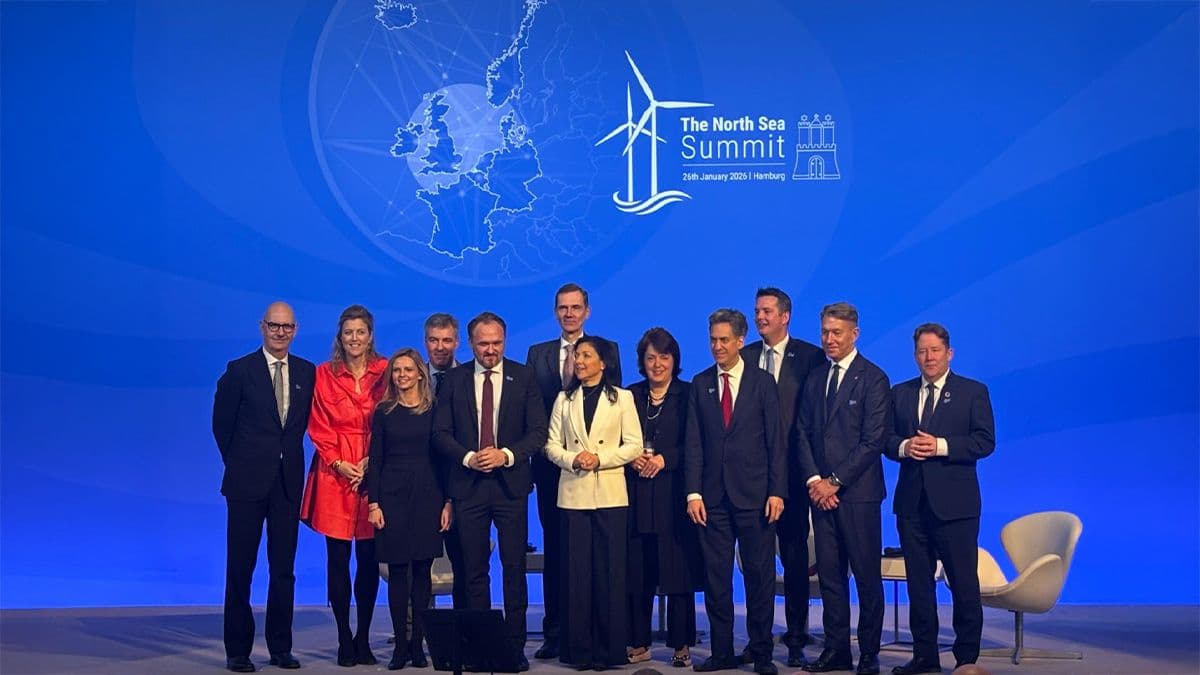
Energy ministers from nine North Sea countries signed the ‘Hamburg Declaration’ at the North Sea Summit in Hamburg on 26 January, agreeing to work towards up to 100 GW of cross-border offshore wind capacity in the North Seas by 2050, while also advancing offshore renewable hydrogen as part of a more integrated regional energy system.
The declaration confirms the wider ambition of reaching 300 GW of offshore wind capacity by 2050, first outlined in earlier Esbjerg and Ostend agreements, and builds on the work undertaken by the North Seas Energy Cooperation (NSEC). The Hamburg Declaration was signed by energy ministers from Belgium, Denmark, France, Germany, Ireland, Luxembourg, the Netherlands, Norway and the United Kingdom, with Iceland joining as an observer to the declaration.
Related Article
Nine North Seas Countries Set 260 GW by 2050 Offshore Wind Target
The new agreement puts a stronger focus on cross-border projects, rather than relying only on national offshore wind developments, as part of a goal to move electricity across borders, improve security of supply and reduce overall system costs.
As a first concrete step, the declaration sees up to 20 GW of cooperation projects that the transmission system operators (TSOs) and developers are already planning for the 2030s, which would open the path towards much larger cross-border offshore wind development later on.
The energy ministers also agreed on the need for closer coordination of offshore grid planning across the North Seas. National offshore plans are expected to better align with regional and European planning processes, while participation remains voluntary and national planning powers are respected.
The declaration also outlines plans to develop an Offshore Financing Framework to support cross-border projects, improve access to capital and ensure that costs and benefits are shared fairly between countries.
